Last Updated: November 1, 2026
Quick Summary
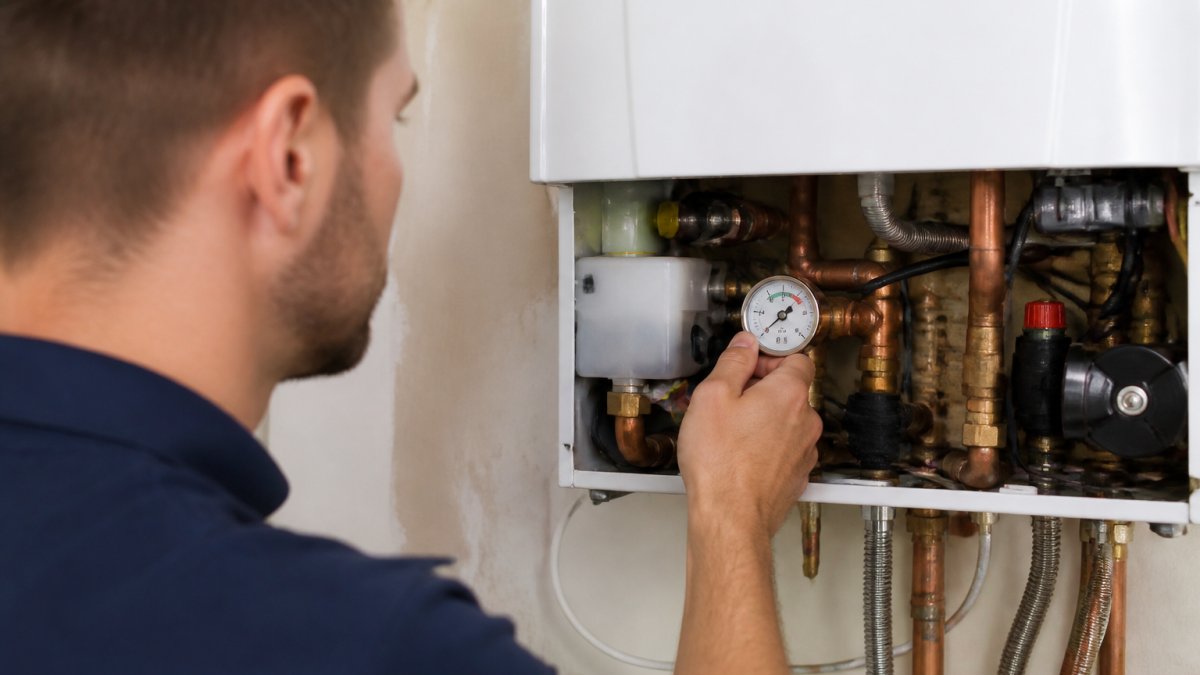
To check boiler pressure at home, find the gauge or digital display on or under the boiler front panel and read it face-on with the heating off and the system cool for at least an hour. Most sealed systems should read between 1 and 1.5 bar when cold, and a reading inside the green zone needs no action.
- A cold reading taken first thing in the morning gives you a sensible baseline.
- A reading of 1.5 to 2 bar while the heating is on is normal because water expands as it heats.
- Top up slowly to 1.2 to 1.5 bar, then run the heating for 15 minutes and recheck once cold.
- Stop and contact a Gas Safe engineer if the gauge reads above 2.5 bar or water appears around the filling loop.
- A drop from 1.5 bar to under 1 bar in weeks is not normal and needs an engineer.
Table of Contents
- Check Boiler Pressure at Home: What You Need Before You Start
- Where to Find the Pressure Gauge or Digital Display
- How to Read a Boiler Pressure Gauge
- What Should Boiler Pressure Be When Cold?
- How to Top Up Boiler Pressure Using the Filling Loop
- Why Boiler Pressure Keeps Dropping and What to Do
- Book a Boiler Pressure Check with a Gas Safe Engineer
- Frequently Asked Questions
Check Boiler Pressure at Home: What You Need Before You Start
Checking boiler pressure at home takes two minutes and no tools. A gauge reading tells you a good deal about the state of a heating system before an engineer visits the property.
Boiler pressure is the reading, in bar, of the water pressure inside your sealed central heating system. It is not the same as your mains water pressure, and it is not the same as the pressure in your hot taps.
Before you start, you need three things:
- Your boiler manual. Every model reads slightly differently. Find the manual or the manufacturer's online version for your exact model.
- A torch. Gauge locations are often dim.
- A clear head about one rule: you are checking, not adjusting. Reading the pressure is a homeowner job. Opening valves and adding water is a different task with its own risks.
The five-step method below takes you from finding the gauge to knowing whether to act. Keep reading, because the difference between a normal reading and a worrying one comes down to one detail most guides skip: whether the boiler is hot or cold when you look.
Where to Find the Pressure Gauge or Digital Display
The pressure gauge sits on or under the boiler front panel, usually on the right-hand side. On a combi boiler, look for a round dial about the size of a £2 coin, or a small LCD screen showing a number followed by "bar".
Where it is not on the boiler itself, check these places:
- Under the boiler: a round dial on the pipework, common on system boilers
- On the front panel: digital LCD displays on newer combi models
- In the airing cupboard: on older system boilers, near the hot water cylinder
If you cannot find it, your boiler manual will show the gauge location for your model. Do not guess.
How to Read a Boiler Pressure Gauge
Reading a boiler pressure gauge means matching the needle or number to a marked scale in bar. Analogue dials show a numbered scale, usually 0 to 4 bar, with coloured bands. The needle points to your current pressure.
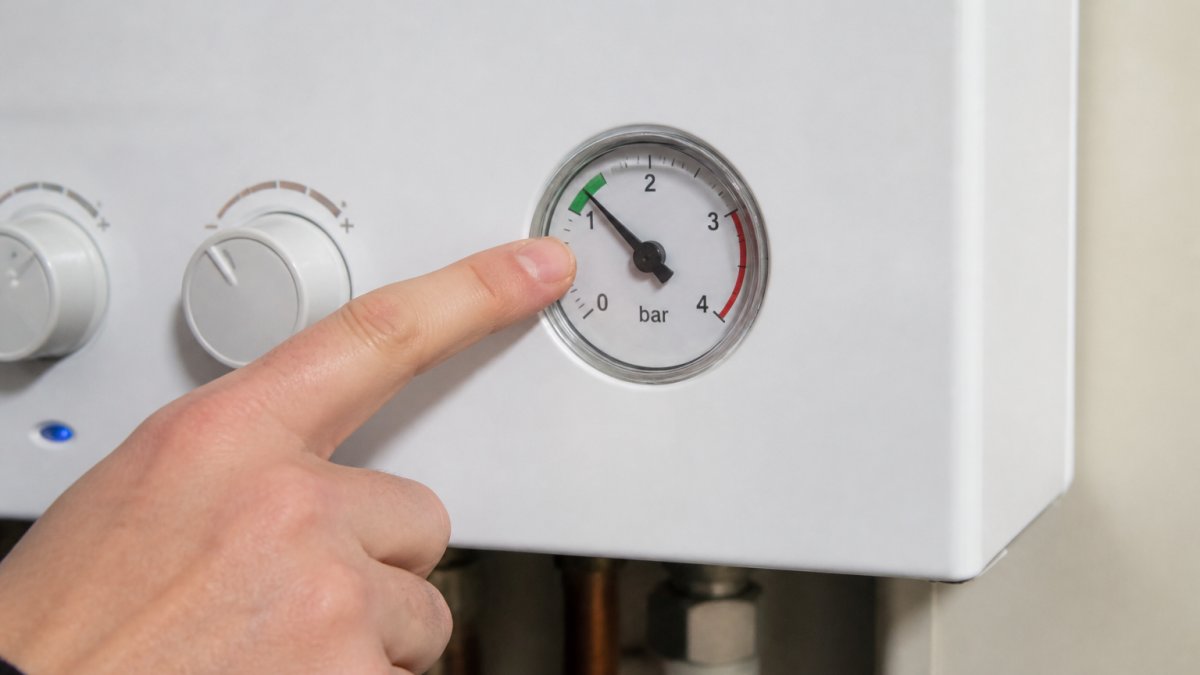
Here is what the markings mean:
- Green zone: the normal range, typically 1 to 1.5 bar when cold
- Red zone: above roughly 2.5 bar, which needs attention
- Below the green zone: low pressure, usually under 1 bar
Read the dial face-on, not at an angle. A needle viewed from the side can look half a bar off. If your boiler has a digital display, the number is exact, so no interpretation is needed.
Take a consistent reading
A reading is only useful if you can compare it with the next one. Follow this sequence so hot and cold readings are never confused:
- Switch the heating off and let the system cool for at least an hour.
- Note the time and the exact reading, including any decimal.
- If the display cycles through several screens, wait until the pressure screen settles before reading.
- Write the figure down, or photograph the gauge, so you have a record.
A cold reading taken first thing in the morning is a sensible baseline. If you check again later the same day, note whether the heating has been running, because a hot reading will be higher and is not directly comparable.
Check your model's manual first
Pressure ranges and gauge layouts vary by model. The manual for your boiler takes precedence over any generic range, and the boiler display itself is the reference point. Some models mark the green zone from 1 to 1.5 bar, others from 1 to 2 bar, and a few digital displays show a target band rather than coloured zones. If the manual and this guide disagree, follow the manual.
What the reading tells you
Once you have a settled cold reading, compare it with the target range in your manual. A reading inside the green zone needs no action. A reading below the green zone is low pressure. A reading above the red zone, or above roughly 2.5 bar cold, is high pressure. The next sections explain what each means and when to stop and call an engineer.
What Should Boiler Pressure Be When Cold?
The correct boiler pressure when cold is between 1 and 1.5 bar for most sealed systems. That is the figure to aim for, and the figure manufacturers design around.
Cold means the heating has been off for at least an hour. Check it in the morning before the heating comes on, or in summer when the system is idle.
When the boiler is running, pressure rises. Water expands as it heats, so a reading of 1.5 to 2 bar while the heating is on is normal. That is why the cold reading is the one that matters: it is your baseline.
A common mistake is topping up a system that reads 1.8 bar while hot. In practice, that system may already be correct when cold. Always check cold before you do anything.
How to Top Up Boiler Pressure Using the Filling Loop
Topping up is only appropriate when the cold reading is below the green zone and you have confirmed the system is cool. Before you touch the filling loop, use this decision path:
- Reading in the green zone: no action. Do not top up.
- Reading below the green zone, cold: top up as described below, then monitor.
- Reading above the red zone, or above roughly 2.5 bar cold: do not top up. See the high-pressure guidance and contact an engineer.
- Reading normal but pressure keeps falling: do not keep topping up. See the section on repeated pressure loss.
If topping up is appropriate, the filling loop is a braided hose, usually under the boiler, with one or two valves. Follow this order:
- Let the system cool completely.
- Find the filling loop and check both ends are connected.
- Open the valve slowly, a quarter turn at a time.
- Watch the gauge while water enters.
- Stop at 1.2 to 1.5 bar, then close the valve fully.
- Run the heating for 15 minutes and recheck once cold.
Top up in small bursts, never in one long go. Overshooting means the pressure relief valve may discharge water, and once that valve has opened it can weep afterwards.
Watch out: if the pressure climbs back up on its own within days of topping up, stop repeating the top-up. Repeated topping up adds fresh water and oxygen to the system, which speeds up corrosion and sludge. That pattern points to a fault, not a maintenance task.
Use this decision path before you touch the filling loop.
| Gauge reading | Action |
|---|---|
| In the green zone | No action; do not top up |
| Below the green zone, cold | Top up, then monitor |
| Above the red zone or above roughly 2.5 bar cold | Do not top up; contact an engineer |
| Normal but pressure keeps falling | Do not keep topping up; see repeated pressure loss |
Why Boiler Pressure Keeps Dropping and What to Do
Pressure loss has a short list of usual causes, and most of them need an engineer. A small drop over a season is normal. A drop from 1.5 bar to under 1 bar in weeks is not.
The common culprits:
- A leak in the system: visible at radiators, valves or pipework, or hidden under floors
- A failed pressure relief valve: discharging water outside through the discharge pipe
- A faulty expansion vessel: pressure swings high when hot and low when cold
- Trapped air after recent work: bled radiators can drop the reading
Check for damp patches near radiators and look at the outside discharge pipe for signs of water. If both are clear and pressure still falls, the fault is internal.
If your boiler keeps losing pressure, it needs a Gas Safe engineer to trace and repair the cause. Our boiler repairs service can help with heating, hot water and pressure faults.
Book a Boiler Pressure Check with a Gas Safe Engineer
Book a boiler pressure check when the gauge reads below 1 bar cold, above 2.5 bar, or when pressure keeps falling after a top-up. Those are the three signals that a reading has moved from "normal" to "needs a look".
Before you book anyone, verify their registration. Ask for the engineer's Gas Safe ID card and check the licence number on the Gas Safe Register.
To arrange a visit, you can contact us. We are Gas Safe registered, and we explain what we find and agree the scope before any work starts.
Frequently Asked Questions
What should my boiler pressure be when it is cold?
When the boiler is cold and has not run for a few hours, the pressure should sit between 1 and 1.5 bar. Most manufacturers print this range in the manual, and many gauges mark it with a green zone. If the needle rests below 1 bar when cold, the system needs topping up. If it sits above 2 bar when cold, stop and call a Gas Safe engineer rather than releasing water yourself.
Why does boiler pressure rise when the heating is on?
Pressure rises as the water in the central heating system heats and expands. A jump from 1.2 bar cold to around 1.8 bar hot is normal. What is not normal is pressure climbing past 2.5 bar or hitting the red zone when hot, because that points to a problem with the expansion vessel or pressure relief valve. Check the reading cold for a like-for-like comparison.
How often should I check boiler pressure?
Check it once a month and before the heating season starts, plus any time the boiler locks out or radiators feel cold at the top. Always take the reading when the system is cold so the figure is consistent. If you notice boiler pressure keeps dropping between checks, log the readings and book an engineer, as repeated loss usually means a leak or a faulty component rather than normal behaviour.
Can I top up boiler pressure myself?
Yes, if your boiler has a filling loop and the pressure is only slightly low, topping up to 1.2 bar is a routine homeowner task. Open the valve slowly, watch the gauge, and close it as soon as you reach the target. Never leave the loop connected or open, and never use it to fix pressure that keeps falling. If you are unsure where the loop is or the pressure will not hold, call a Gas Safe registered engineer.
A gauge reading is useful information, but it is not a diagnosis. If your pressure will not hold, or you are not confident reading your own gauge, get it checked by someone qualified. Get started with Castle Rock Plumbing heating and renewables and arrange a boiler pressure check with a Gas Safe registered engineer who will tell you plainly what is wrong and what it takes to fix it.
