
Last Updated: November 17, 2026
Quick Summary
What does boiler fault code E119 mean? In most Baxi and similar UK boilers, E119 signals that the central heating water pressure has dropped too low for the boiler to run safely. It is a low-pressure fault, not automatically a failed boiler, and the boiler stops heating until pressure is restored.
- Check the pressure gauge first; E119 is usually a low-pressure fault, not a broken boiler.
- Top up cold pressure to the range in your manual, stopping around 1 to 1.5 bar.
- Never fill above your model's stated range, as overfilling can damage the relief valve.
- If pressure keeps falling after topping up, a leak is likely and needs a professional.
- Only a Gas Safe registered engineer should carry out repairs beyond topping up the system.
Table of Contents
- What the E119 Fault Code Means
- Why Boiler Pressure Drops and Causes of Pressure Loss
- What Boiler Pressure Should Be When Cold
- How to Repressurise a Boiler Step by Step
- Why Boiler Pressure Keeps Dropping
- How to Reset a Baxi Boiler After Repressurising
- When to Call a Gas Safe Registered Engineer About E119
- Frequently Asked Questions
What the E119 Fault Code Means
What does boiler fault code E119 mean? In most Baxi and similar UK boilers, E119 signals that the central heating system water pressure has dropped too low for the boiler to run safely. The boiler stops heating and shows the code on its display until the pressure is restored.
The fix is often simple, but only if you know what the code is telling you.
What E119 usually means: low system pressure, not a broken boiler. The boiler is protecting itself from running dry.
E119 is a low-pressure fault. It does not automatically mean the boiler has failed. Check the gauge first. Your boiler manual will confirm the exact code and reset steps for your model.
Why Boiler Pressure Drops and Causes of Pressure Loss
Pressure loss has a few common causes:
- Bled radiators: Venting air from a radiator releases some water, which drops system pressure.
- Small leaks: Leaking radiator valves, pipework joints or a pump seal can slowly lose water.
- Expansion vessel faults: A worn expansion vessel cannot hold pressure steady as the water heats and cools.
- Pressure-relief valve discharge: If the relief valve has opened, water may have escaped from the system.
A slow, steady drop usually points to a leak. A sudden drop after bleeding radiators is often just the expected loss of water. Either way, pressure that keeps falling needs investigating, not just topping up.
What Boiler Pressure Should Be When Cold
Domestic central heating systems are generally filled to a cold pressure within the range stated in the boiler manual, which is the only source that confirms the correct target for your appliance. Some models specify a slightly different cold-fill pressure, and a few sealed-system boilers ask for a figure at the lower or upper end of that band. Your boiler manual is the only source that confirms the correct target for your appliance, so check it before you open the filling loop.
Read the gauge when the system is cold and the boiler has been off for long enough to settle. Pressure rises as water heats and expands, so a reading taken while the heating is running will be higher than the cold figure and is not the number to fill to. If the needle sits at 1 bar cold and climbs to around 1.5 to 2 bar when hot, that is normal expansion behaviour on many systems. If it climbs far beyond that, or the gauge sits near the top of its scale, stop and get advice.
Watch out: never fill above the range your manual specifies. Overfilling raises pressure on the pressure-relief valve and the expansion vessel, and a relief valve that has been forced open may not reseat cleanly, which can leave you with a system that keeps losing pressure.
A practical rule is to fill to the lower half of your model's stated cold range, close the valves, then let the system heat and re-check. If the cold reading falls below 1 bar again within days, that is a recurring loss rather than a one-off top-up, and it needs diagnosis rather than another fill. Keep a note of the date and the reading each time you top up; a simple log makes the pattern obvious and gives an engineer useful information on the first visit.
How to Repressurise a Boiler Step by Step
Before you start, turn the boiler off and let it cool. Make sure the system is cold.
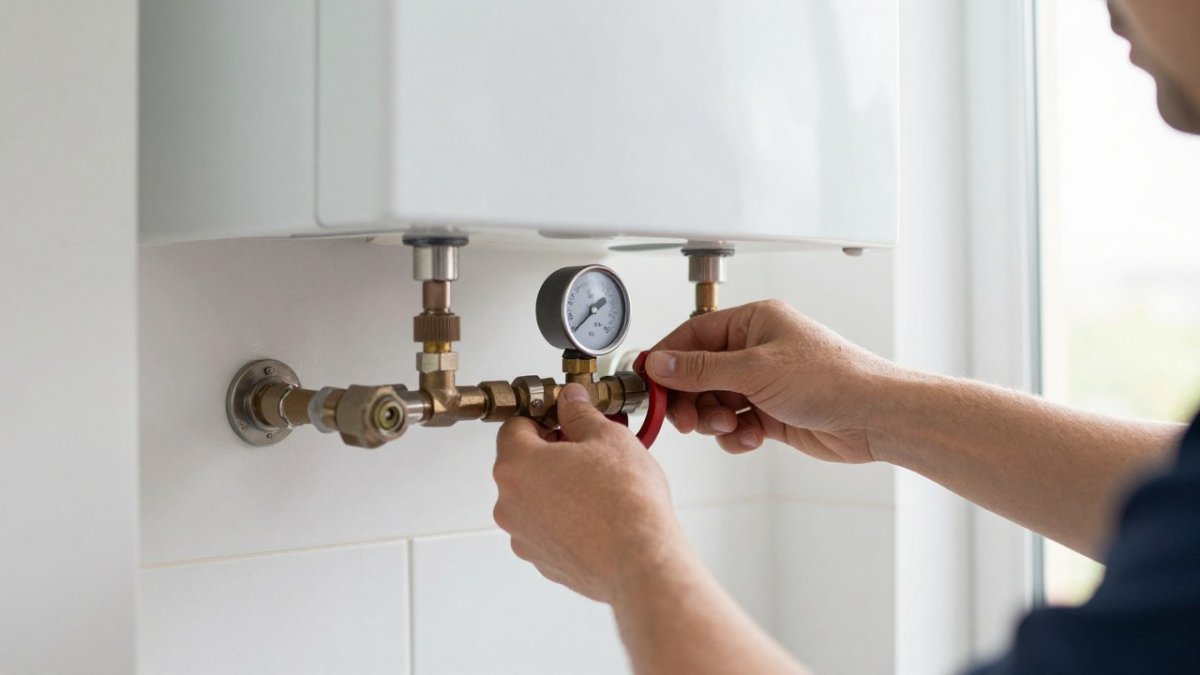
- Find the pressure gauge. It is usually on the front of the boiler, often with a needle showing a reading in bar.
- Read the pressure. If it is below 1 bar, the system needs topping up.
- Locate the filling loop. This is a silver or black flexible hose with two valves, usually under the boiler.
- Open the filling loop slowly. Turn both valves gradually so water flows in. Watch the gauge.
- Stop at 1 to 1.5 bar. Close the valves as soon as the needle reaches the target range.
- Close the filling loop fully. Leaving it open can cause a slow leak or overfilling.
- Restart the boiler. Turn it back on and check that it runs normally.
Watch out: if the gauge keeps dropping after you refill, stop and call a professional. Repeated loss suggests a leak, not a one-off problem.
Using the Filling Loop Safely
Only open the filling loop for as long as you need. Keep your hands clear of the valves while water flows. Never leave the loop open unattended.
The steps for topping up a boiler's pressure, with the timing and checks that go with each one, are summarised below.
| Step | What to do | Time or check |
|---|---|---|
| Let the boiler cool | Turn the boiler off and wait until the system is cold | Before you start |
| Read the gauge | Check the needle on the front of the boiler | Below 1 bar needs topping up |
| Open the filling loop | Turn both valves gradually and watch the gauge | Stop at 1 to 1.5 bar |
| Close the loop fully | Shut both valves so nothing leaks or overfills | Immediately after reaching target |
| Restart the boiler | Turn it back on and check it runs normally | After the loop is closed |
| Watch for repeat loss | Re-check the gauge if pressure falls again | Repeated loss means call a professional |
Why Boiler Pressure Keeps Dropping
If you repressurise the boiler and pressure falls again within days or weeks, the system has a fault. Common culprits include a leaking radiator valve, a pipe joint, a pump seal or a faulty expansion vessel. Look for damp patches, water stains under radiators and drips near the boiler.
Regular servicing can catch these faults early. A Gas Safe registered engineer can test the expansion vessel, check the seals and find the source of the leak.
How to Reset a Baxi Boiler After Repressurising
Once pressure is back in range, you may need to reset the boiler. On many Baxi models, press and hold the reset button for a few seconds until the display clears. The exact button, hold time and sequence vary by model, so check your manual before pressing anything. Some models clear the code automatically once pressure is restored; others need a manual reset; a few require the boiler to be switched off and back on at the controls. Do not assume every Baxi behaves the same way.
Before you reset, confirm three things: the gauge is reading within your model's cold target range, both filling-loop valves are fully closed, and there is no water visible around the loop or under the boiler. Resetting with the loop still open, or with pressure still low, will usually just bring E119 straight back and tells you nothing useful.
If E119 returns after a correct reset, work through this decision path rather than pressing reset repeatedly:
- Pressure still low on the gauge: the system has not held the fill. Re-check that both valves are closed and that the gauge is reading correctly, then top up once more to the target range and reset again. If it still will not hold, stop.
- Pressure in range but E119 persists: the fault may not be pressure-related on your model, or a sensor or switch may be involved. Stop resetting and book an engineer.
- Pressure drops again within days: this is a recurring loss, not a one-off. Note the dates and readings, check for visible drips at radiators and pipework, and arrange a professional diagnosis.
- Boiler will not restart at all: do not keep cycling the power or the reset. Leave it off and call a Gas Safe registered engineer.
Watch out: repeated resets on a boiler that keeps locking out can mask an underlying fault and, on some appliances, cause unnecessary strain. Two or three attempts are enough; beyond that, the code is telling you the problem is not a simple top-up.
Only a Gas Safe registered engineer should open the boiler casing, test the expansion vessel, check the pressure-relief valve or investigate sensors and switches. If you are unsure which step applies to your model, the manual's fault-code table is the place to confirm the reset procedure and any model-specific notes before you touch the controls.
When to Call a Gas Safe Registered Engineer About E119
Call a professional if any of these apply:
- E119 returns soon after repressurising
- The pressure drops quickly or keeps falling
- You can see water leaking from the boiler, pipes or radiators
- The boiler will not restart after a reset
- You smell gas or the boiler is making unusual noises
Only a Gas Safe registered engineer should work on gas appliances. You can check an engineer's registration on the official Gas Safe Register website before work starts, and ask to see their ID card. To book a visit, get in touch through our boiler repairs in Edinburgh service. For installation and servicing, see our boiler installation and repairs in Edinburgh page. If you want to confirm an engineer's credentials first, our guide on how to verify Gas Safe registration step by step walks through the process.
Repeated low pressure, a boiler that will not restart, or any leak should be checked by a professional. Do not attempt repairs beyond topping up the system.
Frequently Asked Questions
What does E119 mean on a Baxi boiler?
On a Baxi boiler, E119 is a low-pressure fault. It means the central heating system water pressure has dropped below the level the boiler needs to run safely, so the boiler shuts down to protect itself. The usual homeowner fix is to check the pressure gauge and repressurise the system using the filling loop, as long as the boiler and pipework show no sign of a leak. If the fault returns quickly after repressurising, the system is losing water and should be inspected by a Gas Safe registered engineer before it is filled again.
Does boiler fault code E119 mean the pressure is too low?
Yes, E119 indicates that the system pressure is too low. Check your manual for the minimum cold pressure your model requires. Checking the gauge is the first step: if the needle sits below the recommended minimum, repressurising the boiler should clear the fault. Pressure that keeps falling, or a boiler that shows E119 again within days, points to a leak or another fault that needs professional diagnosis.
Is it safe to use a boiler with an E119 fault?
A boiler showing E119 has usually shut itself down, so it is not heating your home, and you should not try to override the lockout. Topping up the pressure with the filling loop is a safe homeowner task if the boiler is cold and the pipework is intact. Stop if you hear water escaping, see drips or damp patches, or find the pressure keeps dropping. Any gas appliance fault should be checked by a Gas Safe registered engineer, and you should never attempt internal boiler repairs yourself.
When should I call a Gas Safe registered engineer for E119?
Call a Gas Safe registered engineer if repressurising does not clear E119, if the boiler loses pressure again within a few days, or if you can see a leak from the boiler, radiators or pipework. You should also call if the filling loop will not hold pressure, the gauge does not respond when you fill, or the boiler shows other fault codes. Castle Rock Plumbing, Heating and Renewables' Gas Safe registered engineers can help diagnose the cause and agree the scope of work with you before it starts.
