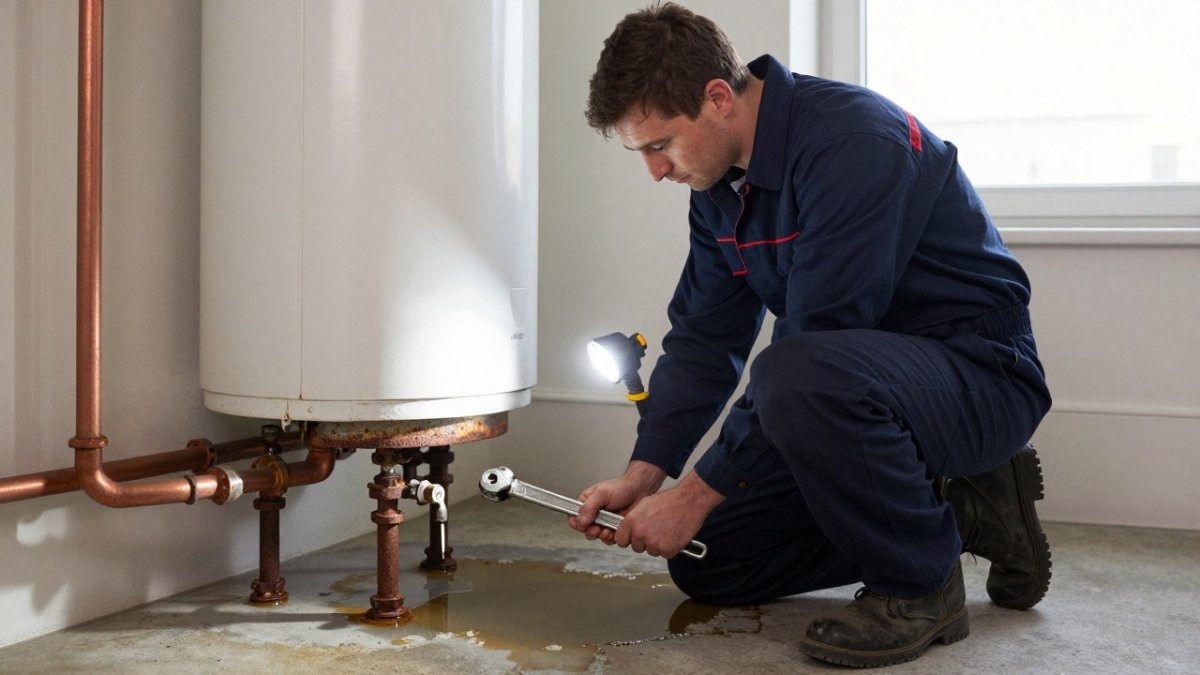
Last Updated: November 10, 2026
Quick Summary
A boiler leaking water from the bottom is usually caused by a faulty pressure relief valve, a blocked or frozen condensate pipe, worn seals, high system pressure or corrosion. Turn the boiler off, catch the drips, and call a Gas Safe registered engineer if the leak continues.
- Turn the boiler off at its on/off switch and place a towel or tray underneath.
- Water at the base of the casing often points to the pressure relief valve or condensate route.
- Water that only appears when the heating is on suggests a failing seal or joint under pressure.
- Boiler pressure should read between 1 and 1.5 bar when cold, so check the gauge.
- Only a Gas Safe registered engineer should open the casing or work on gas components.
Table of Contents
- Why Your Boiler Is Leaking Water From the Bottom
- Safe Actions to Take Straight Away If Your Boiler Is Leaking
- Working Out the Cause From Where and When the Leak Happens
- Why Boiler Pressure Keeps Dropping and Whether It Causes Leaks
- Leak Severity, Urgency and Whether a Leaking Boiler Is Dangerous
- Repair Costs, Warranties and Who Is Responsible
- Booking a Gas Safe Engineer to Find and Fix the Leak
- Frequently Asked Questions
Why Your Boiler Is Leaking Water From the Bottom
A boiler leaking water from the bottom is a common and worrying sight for UK homeowners. Most leaks come from a small number of faults, and many can be traced by looking closely at where the water sits and when it appears. This guide from Castle Rock Plumbing heating and renewables explains what to do first, how to work out the cause, and when to call a Gas Safe registered engineer.
A boiler leaking is rarely a random event. The water usually points to one part of the sealed central heating system that has failed. Knowing the likely suspects makes the fix far easier to plan.
Common causes include:
- High system pressure forcing water past seals
- Worn or failed seals and joints
- Corroded pipes or internal components
- A faulty pressure relief or safety valve
- Heat exchanger damage
- Loose pipe connections
- A failing pump seal
Water that appears under the boiler casing is different from water dripping from a nearby pipe or the condensate outlet. Those are separate problems, and the next sections show how to tell them apart.
Safe Actions to Take Straight Away If Your Boiler Is Leaking
Start with safety. Turn off the boiler at its on/off switch and, if the water is spreading, isolate the electricity supply to it. Place a towel or tray underneath to catch drips and protect the floor.
Do not open the boiler casing or try to remove internal parts. Gas appliances should only be worked on by a Gas Safe registered engineer.
Watch out: never ignore a gas smell. If you smell gas, open windows, leave the property and call the National Gas Emergency Service on 0800 111 999 straight away.
Working Out the Cause From Where and When the Leak Happens
Where the water appears and when it appears are the two most useful clues you have. A leak can often be narrowed to a small number of suspects by answering three questions: where is the water collecting, is the boiler running or idle when it appears, and what colour is the water?
Use the guide below to match what you see to the most likely cause. This is observation only. Do not remove the casing or dismantle any part of the boiler to investigate further.
Water at the very base of the casing
Water pooling at the bottom edge of the boiler, especially at the rear or underneath, most often comes from the pressure relief valve or the condensate route. If the water appears at the pressure relief discharge pipe (usually a copper pipe running outside, often near a drain), the valve is passing. If it appears at the condensate outlet or the white plastic condensate pipe, the cause is condensate-related.
Water from higher up the casing or running down the front
Water that tracks down the front or side of the casing, or that stains the casing itself, points to an internal joint, a seal or the heat exchanger. This is the pattern that most often needs a Gas Safe registered engineer because the source is inside the appliance.
Water at pipe connections around the boiler
Water at the flow and return pipes, at compression fittings or at the isolation valves is usually a loose connection or a perished washer. These are often accessible without opening the casing, but any work on the gas supply or on sealed components still requires a Gas Safe registered engineer.
Water that is not from the boiler at all
Before assuming the boiler is at fault, rule out nearby plumbing. A leaking radiator valve, a failed pipe joint under the floor, a washing machine or dishwasher connection, or a blocked condensate pipe from another appliance can all produce water that appears under the boiler. A common pattern is water that only appears after the heating has run for an hour or more, which often traces to a radiator circuit rather than the boiler itself. If you hear banging alongside the leak, seven common causes of a banging boiler explain whether kettling, sludge or trapped air could be involved.
Timing: heating on versus heating off
Timing narrows the cause further.
- Leak only when the heating is on: pressure rises as the system heats up, so a weak joint, a worn seal or a partially passing pressure relief valve may only show when the system is hot. A leak that starts 20 to 30 minutes after the heating comes on and stops when it cools is a classic sign of a seal or joint that is failing under pressure.
- Leak when the boiler is off: a constant drip with the system cold is more likely to be a loose connection, a worn washer or a condensate issue. A pressure relief valve that drips continuously, even when cold, is usually faulty rather than simply over-pressurised.
- Leak only after hot water use: this can point to the domestic hot water side, including a diverter valve or a plate heat exchanger, rather than the central heating circuit.
Colour and quantity
Clear water is usually from a pipe, valve or condensate route. Rusty, dark or sludgy water suggests corrosion or sludge within the system, which often means a corroded component or a system that needs a flush. A slow drip and a steady stream point to different urgency levels, which the next section covers.
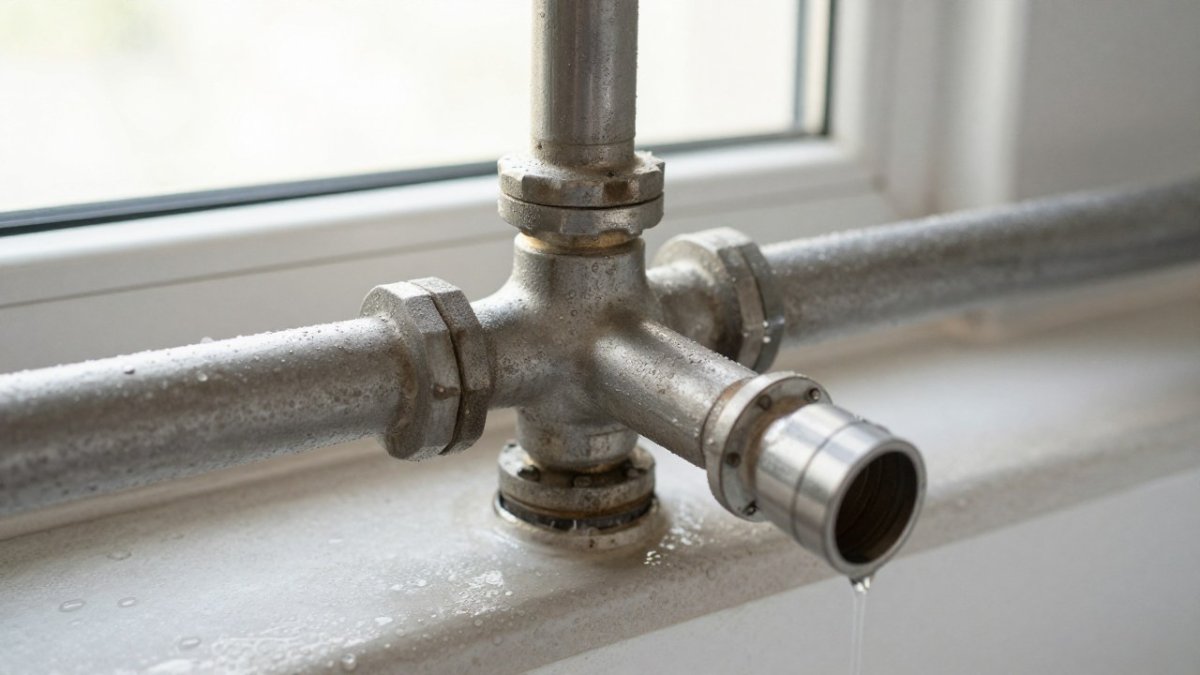
The table below matches where the water appears to its most likely cause, so you can see the pattern at a glance.
| Where the water appears | Most likely cause | Next step |
|---|---|---|
| Base of the casing | Pressure relief valve or condensate route | Check the discharge pipe and condensate outlet |
| Running down the front or side | Internal joint, seal or heat exchanger | Call a Gas Safe registered engineer |
| Flow and return pipe connections | Loose connection or perished washer | Check fittings; engineer for gas-side work |
| Away from the boiler | Radiator valve, pipe joint or other appliance | Rule out nearby plumbing first |
| Only when heating is on | Failing seal or joint under pressure | Monitor pressure; book an engineer |
| Constant drip when cold | Loose connection, worn washer or condensate issue | Inspect fittings and condensate pipe |
Why Boiler Pressure Keeps Dropping and Whether It Causes Leaks
Boiler pressure that keeps dropping is a key warning sign. Pressure usually falls because water is escaping somewhere in the sealed system. That means a leak is likely, even if you cannot see it straight away.
To check pressure, look at the gauge on the boiler when the system is cold. Most boilers show a healthy reading between 1 and 1.5 bar when cold. Pressure that falls below this range, or keeps needing topping up, should be investigated. You can learn how to check boiler pressure at home safely, including finding the gauge and knowing when to act.
Do not repeatedly top up the pressure without finding the cause. Frequent loss means water is leaving the system, and that can damage the boiler over time.
Leak Severity, Urgency and Whether a Leaking Boiler Is Dangerous
A small drip that stays the same is less urgent than a steady stream or a puddle that is growing. Still, any leak from a gas appliance should be checked promptly because water can damage electrics and flooring, and some faults affect safe operation.
Treat the leak as urgent if you see:
- A growing puddle or water near electrical sockets
- Water that keeps coming back after drying
- A boiler that has shut down with an error code
- Any smell of gas or signs of burning
Turn the boiler off and call for help if the leak is significant. A leaking boiler is not always dangerous in itself, but it can signal a fault that affects safety, so do not wait.
Repair Costs, Warranties and Who Is Responsible
Repair costs vary widely depending on the part that has failed, the boiler's age and the work involved. Small fixes such as a valve or seal are usually cheaper than replacing a heat exchanger or a whole boiler. Pricing depends on the exact job, so you should check Castle Rock Plumbing heating and renewables' website for current prices or request a quote once the fault has been assessed. You can compare fitted boiler estimates that include labour and VAT before deciding between repair and replacement.
Check your boiler warranty and any service agreement before paying for repairs. Some manufacturer warranties cover certain faults, while others only apply if the boiler has been serviced by a registered engineer. Your landlord may also be responsible for repairs in a rented property, so check your tenancy agreement.
For a clear and fair outcome, ask for a written scope of work before any repair begins. This helps you understand what is included and what is not.
Booking a Gas Safe Engineer to Find and Fix the Leak
A Gas Safe registered engineer is the right person to diagnose and fix a leaking boiler. They can check pressure, inspect seals and joints, test the pressure relief valve and confirm that the appliance is safe to use.
Before any work starts, confirm that the engineer is Gas Safe registered. Ask to see their ID card and check the register online. Look for the engineer's qualifications for the type of work needed (Check an engineer - are they Gas Safe registered?).
Castle Rock Plumbing heating and renewables offers boiler repairs in Edinburgh. Our Gas Safe registered engineers explain the options, agree the scope before work begins, and give a clear quote. Book a boiler repair in Edinburgh to get the leak checked properly.
Finding the cause quickly prevents further damage and keeps your home safe. A short call now is far cheaper than a flooded kitchen later.
Final section: Booking a Gas Safe Engineer to Find and Fix the Leak
Frequently Asked Questions
Why is my boiler leaking water from the bottom?
Water collecting under a boiler usually comes from one of a few places: a worn or failed pump seal, a loose or corroded pipe joint, a faulty pressure relief valve discharging, a cracked heat exchanger, or a blocked or frozen condensate pipe. The exact spot where the water appears, and whether it drips steadily or only when the heating is running, helps narrow it down. Because several of these causes look similar, a Gas Safe registered engineer should confirm the source before any part is replaced.
Is a boiler leaking from underneath dangerous?
It can be. Water near the boiler's electrical controls and gas components creates a risk, and a leak can also signal a pressure or internal fault that needs attention. If there is any smell of gas, leave the property and call the National Gas Emergency Service on 0800 111 999. Otherwise, switch the boiler off and arrange a Gas Safe engineer promptly.
Can I still use my boiler if it is leaking water?
It is safest not to. Running a leaking boiler can cause further damage to the boiler and surrounding property, and low pressure from the leak can stop the system working correctly. Switch the boiler off, close the water supply to the heating system if you know how, and avoid restarting it until a Gas Safe registered engineer has inspected it. Repairs are usually simpler and cheaper when the fault is caught early.
When should I call a Gas Safe registered engineer?
Call one as soon as you notice water under the boiler, especially if it is repeating, if the pressure gauge is reading low, or if you cannot identify the source. Only a Gas Safe registered engineer is legally permitted to carry out work on gas appliances in the UK. You can check a Gas Safe registration on the Gas Safe Register website before the engineer starts work.
